A crank radio for home preparedness should do three things: receive the stations your authorities use for warnings, charge without the grid in at least two ways, and give you light and a little power for your phone. Choose by band first, then charging, then the extras. When the power and the mobile network go down, a radio is often the only way to hear what is happening. MCF, the Swedish Agency for Civil Defence recommends every household manage at least one week on its own, and staying informed is part of that.
1. The right band for where you live
In Sweden, public warnings (VMA) go out on Sveriges Radio P4, which you receive on FM. In Denmark the advice when the sirens sound is to listen to DR, and in Finland Yle broadcasts on FM. Norway is different: the national channels moved to DAB in 2017, and FM is now mainly local radio. If you live in Norway and want NRK, you need DAB.
Check the frequency range, not just "AM/FM" on the box. FM should cover 87.5 to 108 MHz.
2. Charging without the grid
- USB is the main way. Charge the radio fully before it goes into storage and top it up a couple of times a year.
- The crank is the reserve that always works. It is slow, but it does not depend on the weather.
- The solar panel tops up slowly in daylight.
A radio with all three is never flat for long. Choose a common connector such as USB-C, so a cable you already have works.
3. Light, phone power and SOS
Most crank radios have a torch, and some also a reading light. A built-in power bank can give your phone enough for a call or a message. It does not replace a real power bank. An SOS function with an alarm sound and a flashing light makes you heard and seen.
4. Small enough to keep in sight
A radio you can find in the dark is worth more than a better one in the attic. Choose one small enough to stand in the hall or on a shelf, together with the rest of your preparedness.
What the tests say
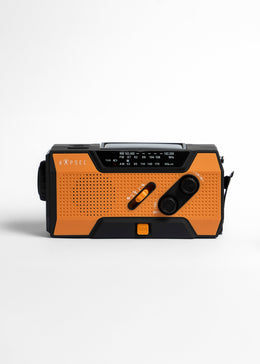
Kapsel's crank radio is second of nine in Testproffs' Swedish crank radio test, first and Best i test 2026 in Testekspert's Norwegian emergency radio test, and second in Testeksperterne's Danish test.
How the Kapsel crank radio measures up
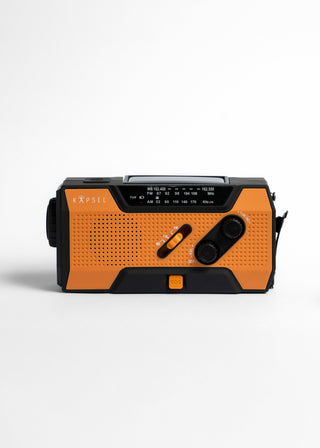
- FM 87.5 to 108 MHz, with AM and WB on the same dial. No DAB, which matters in Norway.
- Charges by USB-C, solar panel or crank. USB-C cable included.
- Built-in power bank with a USB output, enough for a call or a message.
- LED torch and reading light.
- SOS button with an alarm sound and a flashing light.
- 330 grams, 15.7 × 7.4 × 5.3 cm.
- Tested against the EU radio equipment directive, including the FM receiver standards EN 303 345-1 and EN 303 345-3.
See the Kapsel crank radio. It is also part of the Kapsel Core preparedness system, with over 30 components for seven days. Read more about VMA and staying informed in a crisis.
Frequently asked questions
What should I look for when buying a crank radio?
The right band for your country's warnings, at least two ways to charge without the grid, a torch and an SOS function. In Sweden, Denmark and Finland FM is enough. In Norway you need DAB to hear NRK.
Does a crank radio work when the power is out?
Yes, that is the point. Charged beforehand by USB, it runs without the grid, and the crank and the solar panel can top it up when the power is gone.
Can a crank radio charge my phone?
Many can, through a built-in power bank. Expect enough for a call or a message, not a full charge. Keep a separate power bank for the phone.
How do I keep a crank radio ready?
Charge it fully before you store it, check it a couple of times a year, and keep it where you can find it in the dark.
Sources: MCF, the Swedish Agency for Civil Defence, krisinformation.se on VMA and warning signals, DSB on self-preparedness, Styrelsen for Samfundssikkerhed, 72tuntia.fi.
Want the complete system, with everything in its place?
See the full system